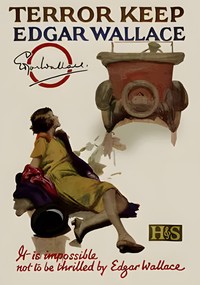
TERROR KEEP
FOREWARD
/Rightly/ speaking, it is improper, not to say illegal, for those
sadly privileged few who go in and out of Broadmoor Criminal Asylum,
to have pointed out to them any particular character, however
notorious he may have been or to what heights of public interest his
infamy had carried him, before the testifying doctors and a merciful
jury consigned him to this place without hope. But often had John
Flack been pointed out as he shuffled about the grounds, his hands
behind him, his chin on his breast, a tall, lean old man in an
ill-fitting suit of drab clothing, who spoke to nobody and was spoken
to by few.
“That is Flack–the Flack; the cleverest crook in the world… Crazy
John Flack… nine murders…”
Men who were in Broadmoor for isolated homicides were rather proud of
Old John in their queer, sane moments. The officers who locked him up
at night and watched him as he slept had little to say against him,
because he gave no trouble, and through all the six years of his
incarceration had never once been seized of those frenzies which so
often end in the hospital for some poor innocent devil, and a
rubber-padded cell for the frantic author of misfortune.
He spent most of his time writing and reading, for he was something of
a genius with his pen, and wrote with extraordinary rapidity. He
filled hundreds of little exercise books with his great treatise on
crime. The Governor humoured him; allowed him to retain the books,
expecting in due course to add them to his already interesting museum.
Once, as a great concession, old Jack gave him a book to read, and the
Governor read and gasped. It was entitled “Method of robbing a bank
vault when only two guards are employed.” The Governor, who had been
a soldier, read and read, stopping now and then to rub his head; for
this document, written in the neat, legible hand of John Flack, was
curiously reminiscent of a divisional order for attack. No detail was
too small to be noted; every contingency was provided for. Not only
were the constituents of the drug to be employed to “settle the outer
watchman” given, but there was an explanatory note which may be
quoted:
“If this drug is not procurable, I advise that the operator should
call upon a suburban doctor and describe the following symptoms… The
doctor will then prescribe the drug in a minute quantity. Six bottles
of this medicine should be procured, and the following method adopted
to extract the drug…”
“Have you written much like this, Flack?” asked the wondering officer.
“This?” John Flack shrugged his lean shoulders. “I am doing this for
amusement, just to test my memory. I have already written sixty-three
books on the subject, and those works are beyond improvement. During
the six years I have been here, I have not been able to think of a
single improvement to my old system.”
Was he jesting? Was this a flight of a disordered mind? The Governor,
used as he was to his charges and their peculiar ways, was not
certain.
“You mean you have written an encyclopaedia of crime?” he asked
incredulously. “Where is it to be found?”
Old Flack’s thin lips curled in a disdainful smile, but he made no
answer.
Sixty-three hand-written volumes represented the life work of John
Flack. It was the one achievement upon which he prided himself.
On another occasion when the Governor referred to his extraordinary
literary labours, he said:
“I have put a huge fortune in the hands of any clever man–providing,
of course,” he mused, “that he is a man of resolution and the books
fall into his hands at a very early date–in these days of scientific
discovery, what is a novelty to-day is a commonplace to-morrow.”
The Governor had his doubts as to the existence of these deplorable
volumes, but very soon after the conversation took place he had to
revise his judgment. Scotland Yard, which seldom if ever chases
chimerae, sent down one Chief-Inspector Simpson, who was a man
entirely without imagination and had been promoted for it. His
interview with Crazy John Flack was a brief one.
“About these books of yours, Jack,” he said. “It would be terrible if
they fell into wrong hands. Ravini says you’ve got a hundred volumes
hidden somewhere—-”
“Ravini?” Old John Flack showed his teeth. “Listen, Simpson! You don’t
think you’re going to keep me in this awful place all my life, do you?
If you do, you’ve got another guess coming. I’ll skip one of these odd
nights–you can tell the Governor if you like–and then Ravini and I
are going to have a little talk.”
His voice grew high and shrill. The old mad glitter that Simpson had
seen before came back to his eyes.
“Do you ever have day-dreams, Simpson? I have three! I’ve got a new
method of getting away with a million: that’s one, but it’s not
important. Another one is Reeder: you can tell J. G. what I say. It’s
a dream of meeting him alone one nice, dark, foggy night, when the
police can’t tell which way the screams are coming. And the third is
Ravini. George Ravini’s got one chance, and that is for him to die
before I get out!”
“You’re mad,” said Simpson.
“That’s what I’m here for,” said John Flack truthfully.
This conversation with Simpson and that with the Governor were two of
the longest he ever had, all the six years he was in Broadmoor. Mostly
when he wasn’t writing he strolled about the grounds, his chin on his
chest, his hands clasped behind him. Occasionally he reached a certain
place near the high wall, and it is said that he threw letters over,
though this is very unlikely. What is more possible is that he found a
messenger who carried his many and cryptic letters to the outer world
and brought in exchange monosyllabic replies. He was a very good
friend of the officer in charge of his ward, and one early morning
this man was discovered with his throat cut. The ward door was open,
and John Flack had gone out into the world to realise his day-dreams.



Comments
Loading comments…