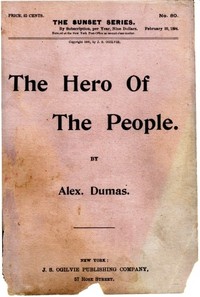
LOCKSMITH AND GUNSMITH.
The French Revolution had begun by the Taking of the Bastile by the
people of Paris on the Fourteenth of July, 1789, but it seemed to have
reached the high tide by King Louis XVI, with his Queen Marie Antoinette
and others of the Royal Family, leaving Versailles, after some
sanguinary rioting, for the Capital, Paris.
But those who think, in such lulls of popular tempests, that all the
mischief has blown over, make a mistake.
Behind the men who make the first onset, are those who planned it and
who wait for the rush to be made and, then, while others are tried or
satisfied, glide into the crowds to stir them up.
Mysterious agents of secret, fatal passions, they push on the movement
from where it paused, and having urged it to its farthest limit, those
who opened the way are horrified, at awakening to see that others
attained the end.
At the doorway of a wine saloon at Sevres by the bridge, over the Seine,
a man was standing who had played the main part, though unseen, in the
riots which compelled the Royal Family to renounce an attempt to escape
out of the kingdom like many of their sycophants, and go from Versailles
Palace to the Tuileries.
This man was in the prime of life: he was dressed like a workingman,
wearing velveteen breeches shielded by a leather apron with pockets such
as shinglers wear to carry nailes in, or blacksmith-farriers or
locksmiths. His stockings were grey, and his shoes had brass buckles; on
his head was a fur cap like a grenadier’s cut in half or what is called
nowadays an artillerist’s busby. Grey locks came straggling from under
its hair and mingled with shaggy eyebrows; they shaded large bulging
eyes, keen and sharp, quick, with such rapid changes that it was hard to
tell their true color. His nose was rather thick than medium, the lips
full, the teeth white, and his complexion sunburnt.
Without being largely built, this man was well formed: his joints were
not course and his hands were small and might have seemed delicate but
for their being swart like those of workers in metal.
Despite the vigor of the biceps muscle shown from his having rolled up
his shirt sleeves, the skin was remarkable for its whiteness, and almost
aristocratically fine.
Within his reach was a richly gold-inlaid double-barrelled fowling
piece, branded with the name of Leclere, the fashionable gunsmith of
Paris. You may ask how could such a costly firearm come into the hands
of a common artisan? In times of riot it is not always the whitest hands
which grasp the finest weapons.
This man had only arrived from Versailles since an hour, and perfectly
well knew what had happened there: for to the landlord’s questions as he
supplied him with a bottle of wine which he did not touch, he had
answered as follows:
“The Queen is coming along with the King and the Dauphin. They had
started at half afternoon, having at last decided to live at the
Tuileries; in consequence of which for the future Paris would no longer
want for bread, as it would have in her midst, the Baker, the Baker’s
Wife and the Baker’s Boy, as the popular slang dubbed the three
‘Royals’.”
As for himself, he was going to hang round to see the procession go by.
This last assertion might be true, although it was easy to tell that his
glance was more often bent on the side towards Paris than Versailles,
which led one to surmise that he did not feel obliged to tell Boniface
exactly what his intentions were.
In a few seconds his attraction seemed gratified, for he spied a man,
garbed much like himself, and appearing of the same trade, outlined on
the ridge of the road. He walked heavily like one who had journeyed from
afar.
His age appeared to be like his awaiter’s, that is, what is called the
wrong side of forty. His features were those of a common fellow with low
inclinations and vulgar instincts.
The stranger’s eye was fastened on him with an odd expression as if he
wished with a single scrutiny to measure the gold, if any, and the alloy
in his composition.
When the wayfarer from the town was within twenty steps of this man
lounging in the doorway, the latter stepped inside, poured the wine from
the bottle into two glasses and returning to the doorstep with one
tumbler held up, he hailed him:
“Hello, mate! it is pretty cold weather, and the road is a long one.
What do you say to our having a drop of the red to cheer us up and warm
us?”
The workman from town looked round to make sure that he was alone and
that the greeting was addressed to him.
“Speaking to me, are you?”
“Who else, as you are alone?”
“And offering me a go of wine?”
“Why not, as we are brothers of the file and bossing-hammer alike? or
some at nigh.”
“Anybody can belong to a trade,” said the other looking hard at the
speaker; “but the point is, are you a greenhand or a master of the
craft?”
“I reckon we shall tell how far we have learnt the trade while drinking
and chatting together.”
“All right then!” said the other, walking up to the door, while the
inviter showed the table set out with the wine. The man took the
tumbler, eyed the contents as if he had doubts, but they disappeared
when the stranger poured himself out a second brimmer.
“Why, hang it all, are you getting so proud that you will not drink with
a shopmate?”
“No, dash me if I am–here is Good Luck to the Nation!”
The workman’s grey eyes were fixed on the toast-giver’s.
He tossed off the glass at a draft, and wiped his lips on his sleeve.
“Deuse take it, but it is Burgundy wine,” he remarked.
“And good liquor, too, eh? the vintage was recommended to me; and
happening along I dropped in, and I am not repenting it. But why not sit
down and be at home? there is some more in the bottle and more in the
cellar when that is gone.”
“I say, what are you working at here?”
“I have knocked off for the day. I finished a job at Versailles and I am
going on to Paris with the royal procession as soon as it comes along.”
“What procession?”
“Why, the King and the Queen and the little Prince, who are returning to
the city with the Fishmarket women and two hundred Assemblymen, all
under protection of Gen. Lafayette and the National Guard.”
“So the fat old gentleman has decided to come to town?”
“They made him do it.”
“I suspected so when I started for Paris at three this morning.”
“Hello! did you leave Versailles at three without any curiosity about
what was going off?”
“No, no, I itched to know what the gent was up to, being an
acquaintance, a chum of mine, by the way, though I am not bragging; but
you know, old man, one must get on with the work. I have a wife and
children to provide for, and it is no joke now. I am not working at the
royal forge.”
The listener let what he heard pass without putting any questions.
“So, it was on a pressing job that you went back to Paris?” he only
inquired.
“Just that, as it appears, and handsomely paid too,” said the workman,
jingling some coin in his pocket, “though it was paid for by a kind of
servant, which was not polite, and by a German, too, which blocked me
from having any pleasant chatter during the work. I am not one for gab,
but it amuses one if no harm is spoken of others.”
“And it is no harm when harm is spoken of the neighbors, eh?”
Both men laughed, the stranger showing sound teeth against the other’s
snaggy ones.
“So, then, you have knocked off a good job, wanted doing in a hurry, and
well paid?” said the former, like one who advances only a step at a
time, but still does advance. “Hard work, no doubt?”
“You bet it was hard. Worse than a secret lock–an invisible door. What
do you think of one house inside of another? some one who wants to hide
away, be sure. What a game he could have–in or out, as he pleased.
‘Your master in?’ ‘No, sir: just stepped out.’ ‘You are a liar–he came
in just now.’ ‘You had better look, since you are so cocksure.’ So they
look round, but I defy them to find the gentleman. An iron door, you
will understand, which closes on a beading-framed panel, while it runs
on balls in a groove as on wheels. On the metal is a veneer of old oak,
so that you can rap with your knuckles on it and the sound is identical
with that of a solid plank. I tell you when the job was done, it would
take me in myself.”
“Where the mischief would you do a job like that? but I suppose you
would not tell even a pal?”
“I cannot tell because I do not know.”
“What hoodwinked you?”
“Guess again and you will be wrong. A hack was waiting for me at the
city turnpike bars. A chap came up and asked: ‘Are you so and-so?’ I
said ‘I am.’ ‘Good, we are waiting for you: jump in.’ So I got inside
the coach, where they bandaged my eyes, and after the wheels had gone
round for about half an hour, a big carriage-door was opened. They took
me out and up ten steps of a flight of stairs into a vestibule, where I
found a German servant who said to the others: ‘Goot! make scarce of
yourseluffs; no longer want we you.’ They slung their hook out of it,
while the blinders were taken me off, and I was shown what I had to do.
I had pitched into the work like a good hand, and was done in an hour.
They paid me in bran-new gold, tied up my eyes, put me back in the
carriage, dropped me on the same spot where I was taken up, wished me
safe home–and here I am.”
“Without your having seen anything, even out of the tail of the eye?
Deuse take me if ever I heard of a bandage which would stop a man
catching a glimpse on one side or t’other. Better own up that you had a
peep at something?” pursued the stranger.
“Well, I did make a misstep at the first stone of the stairs so that, in
throwing up my hands to keep from falling, I got a peep from its
disarranging the handkerchief. I saw a regular row of trees on my left
hand which made me think that I was in some avenue. That is all, on my
honor.”
“I can’t say it is much. For the main avenue is long and more than one
house has a carriage-doorway betwixt the St. Honore Coffeehouse and the
Bastile.”
“The fact is,” said the locksmith, scratching his head, “I don’t think I
am up to telling the house.”
The questioner appeared satisfied, although his countenance did not
usually betray his feelings.
“But,” exclaimed he, as if skipping to another topic, “are there no good
locksmiths at Paris that they have to send to Versailles for one?”


Comments
Loading comments…