Produced by Al Haines.
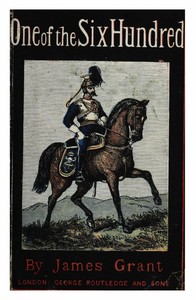
*ONE OF
THE SIX HUNDRED*
*A Novel*
BY JAMES GRANT
AUTHOR OF “THE ROMANCE OF WAR.”
“Half a league, half a league,
Half a league, onward,
Into the Valley of Death,
Rode the Six Hundred!”
TENNYSON.
LONDON:
GEORGE ROUTLEDGE AND SONS
THE BROADWAY, LUDGATE
NEW YORK: 416 BROOME STREET
1875
*ONE OF THE SIX HUNDRED.*
*CHAPTER I.*
To be handsome, young, and twenty-two,
With nothing else on earth to do;
But all day long to bill and coo,
It were a pleasant calling.–THACKERAY.
I was just in the act of humming the above verse, when the following
announcement was put into my hand–
“Regimental Orders.–Head-quarters, Maidstone, December 31st.
“As the regiment is to be held in readiness for foreign service in
spring, captains of troops will report to Lieutenant and Adjutant
Studhome, for the information of the commanding officer, on the state of
the saddlery, the holsters and lance-buckets; and the horses must be all
re-shod under the immediate inspection of the veterinary surgeon and
Farrier-Sergeant Snaffles.
“Leave of absence to the 31st proximo is granted to Lieutenant Newton
Calderwood Norcliff, in consequence of his urgent private affairs.”
“Hah! this is what most concerns _me_,” I exclaimed, as I read the
foregoing, and then handed the order-book, a squat vellum-bound quarto,
to the orderly-serjeant who was in waiting.
“Any idea of where we are likely to go, sir?” he asked.
“The East, of course.”
“So say the men in the barracks; for the present, good-bye, sir,” said
he, as he wheeled about on his spurred heel, and saluted; “I wish you a
pleasant journey.”
“Thanks, Stapylton,” said I; “and now to be off by the night train for
London and the north. Ugh! the last night of December; I shall have a
cold journey of it.”
Despatching my man, Willie Pitblado–of whom more hereafter–to the
mess-house to report that I should not dine there that evening, I
proposed at once to start for home, resolved to make the most of the
favour granted me–leave between returns, as it is technically termed.
I propose to give the story of my own adventures, my experiences of
life, or autobiography (what you will); and this I shall do, in the face
of a certain writer, who asserts, with some truth, doubtless, that she
does not “believe that there was, or could be in the world, a wholly
true, candid, and unreserved biography, revealing all the dispositions,
or even, without exception, _all the facts of any existence_. Indeed,”
she adds, “the thing is next to impossible; since, in that case, the
subject of the biography must be a man or woman without reserve, without
delicacy, and without _those secrets_ which are inevitable even to the
most stainless spirit.”
With all due deference to this fair writer, I beg to hope that such a
candid spirit may exist; and that, without violating the delicacy of
this somewhat (externally) fastidious age on the one hand, and without
prudish or hypocritical reserve on the other, I, Mr. Newton Norcliff,
will relate the plain, unvarnished story of a cavalry subaltern’s life
during the stirring events of the last ten years.
My regiment was a lancer one. I need not designate it further; though,
by the way, it has always struck me as somewhat peculiar in our cavalry
of the line, that while we have our Scottish corps, the famous old
Greys, and no less than three Irish, we have not one English regiment,
provincially designated as such.
I despatched a note of thanks to the colonel, handed over my cattle to
the care of my friend Jack Studhome, the adjutant, and had a hasty
interview with Saunders M’Goldrick, our Scots paymaster–not that I wish
the reader to infer that he was my chief factor and reliance (heaven
help those in a dragoon regiment who find him so!).
Glad to escape, even for the brief period of a month, from the monotony
of routine parades, the stable duty, the barrack life, and useless
hurly-burly of Maidstone–to be free from all bother, mess, band, and
ball committees, courts-martial, and courts of inquiry; from having to
remember when this parade took place, and when that particular drill,
and all that sort of thing–glad, I say, to escape from being saluted by
soldiers and sentinels at every turn and corner, and to be once again
lord of my own proper person, I relinquished my gay lancer trappings,
and resumed the less pretending mufti of the civilian–a suit of warm
and strong heather-mixture tweed–and about nine o’clock P.M. found
myself, with some light travelling baggage, my gun-case, railway rugs,
&c. (in care of Willie Pitblado, who was attired in very orthodox
livery–boots, belt, and cockade), awaiting the up train for London, at
the Maidstone station, and enjoying a last friendly chat and a cigar
with Studhome, as we promenaded to and fro on the platform, and talked
of the different work that would soon be cut out for us, too probably,
about the time my short leave expired.
The British fleet was already in the Bosphorus; the field of Oltenitza
had seen the terrible defeat of the Russians by the troops of Omar
Pasha, generalissimo of the Porte, avenge the recent naval massacre at
Sinope. Ere long, the Turks were to be again victorious at Citate.
General Luders was about to force his way into the Dobrudcha; Britain,
France, Russia, Turkey, and Sardinia were gathering their hosts for the
strife; and amid these serious events, that absurdity might not be
wanting, the sly broad-brims and popularity-hunters of the Peace Society
sent a deputation to the Emperor Nicholas, to expostulate with him on
the wickedness of his ways.



Comments
Loading comments…