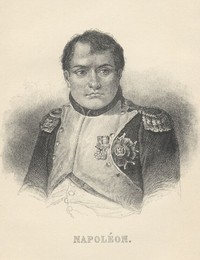
PREFACE 1836 EDITION.
In introducing the present edition of M. de Bourrienne’s Memoirs to
the public we are bound, as Editors, to say a few Words on the subject.
Agreeing, however, with Horace Walpole that an editor should not dwell
for any length of time on the merits of his author, we shall touch but
lightly on this part of the matter. We are the more ready to abstain
since the great success in England of the former editions of these
Memoirs, and the high reputation they have acquired on the European
Continent, and in every part of the civilised world where the fame of
Bonaparte has ever reached, sufficiently establish the merits of M. de
Bourrienne as a biographer. These merits seem to us to consist chiefly
in an anxious desire to be impartial, to point out the defects as well
as the merits of a most wonderful man; and in a peculiarly graphic power
of relating facts and anecdotes. With this happy faculty Bourrienne
would have made the life of almost any active individual interesting;
but the subject of which the most favourable circumstances permitted
him to treat was full of events and of the most extraordinary facts. The
hero of his story was such a being as the world has produced only on the
rarest occasions, and the complete counterpart to whom has, probably,
never existed; for there are broad shades of difference between Napoleon
and Alexander, Caesar, and Charlemagne; neither will modern history
furnish more exact parallels, since Gustavus Adolphus, Frederick the
Great, Cromwell, Washington, or Bolivar bear but a small resemblance
to Bonaparte either in character, fortune, or extent of enterprise. For
fourteen years, to say nothing of his projects in the East, the history
of Bonaparte was the history of all Europe!
With the copious materials he possessed, M. de Bourrienne has produced
a work which, for deep interest, excitement, and amusement, can scarcely
be paralleled by any of the numerous and excellent memoirs for which the
literature of France is so justly celebrated.
M. de Bourrienne shows us the hero of Marengo and Austerlitz in his
night-gown and slippers–with a ‘trait de plume’ he, in a hundred
instances, places the real man before us, with all his personal habits
and peculiarities of manner, temper, and conversation.
The friendship between Bonaparte and Bourrienne began in boyhood, at the
school of Brienne, and their unreserved intimacy continued during the
most brilliant part of Napoleon’s career. We have said enough, the
motives for his writing this work and his competency for the task will
be best explained in M. de Bourrienne’s own words, which the reader will
find in the Introductory Chapter.
M. de Bourrienne says little of Napoleon after his first abdication and
retirement to Elba in 1814: we have endeavoured to fill up the chasm
thus left by following his hero through the remaining seven years of
his life, to the “last scenes of all” that ended his “strange, eventful
history,”–to his deathbed and alien grave at St. Helena. A completeness
will thus be given to the work which it did not before possess, and
which we hope will, with the other additions and improvements already
alluded to, tend to give it a place in every well-selected library, as
one of the most satisfactory of all the lives of Napoleon.
LONDON, 1836.
PREFACE 1885 EDITION.
The Memoirs of the time of Napoleon may be divided into two
classes–those by marshals and officers, of which Suchet’s is a good
example, chiefly devoted to military movements, and those by persons
employed in the administration and in the Court, giving us not only
materials for history, but also valuable details of the personal and
inner life of the great Emperor and of his immediate surroundings.
Of this latter class the Memoirs of Bourrienne are among the most
important.
Long the intimate and personal friend of Napoleon both at school and
from the end of the Italian campaigns in 1797 till 1802–working in the
same room with him, using the same purse, the confidant of most of
his schemes, and, as his secretary, having the largest part of all
the official and private correspondence of the time passed through
his hands, Bourrienne occupied an invaluable position for storing and
recording materials for history. The Memoirs of his successor, Meneval,
are more those of an esteemed private secretary; yet, valuable and
interesting as they are, they want the peculiarity of position which
marks those of Bourrienne, who was a compound of secretary, minister,
and friend. The accounts of such men as Miot de Melito, Raederer, etc.,
are most valuable, but these writers were not in that close contact with
Napoleon enjoyed by Bourrienne. Bourrienne’s position was simply unique,
and we can only regret that he did not occupy it till the end of the
Empire. Thus it is natural that his Memoirs should have been largely
used by historians, and to properly understand the history of the time,
they must be read by all students. They are indeed full of interest for
every one. But they also require to be read with great caution. When
we meet with praise of Napoleon, we may generally believe it, for, as
Thiers (Consulat., ii. 279) says, Bourrienne need be little suspected
on this side, for although he owed everything to Napoleon, he has not
seemed to remember it. But very often in passages in which blame is
thrown on Napoleon, Bourrienne speaks, partly with much of the natural
bitterness of a former and discarded friend, and partly with the curious
mixed feeling which even the brothers of Napoleon display in their
Memoirs, pride in the wonderful abilities evinced by the man with whom
he was allied, and jealousy at the way in which he was outshone by the
man he had in youth regarded as inferior to himself. Sometimes also we
may even suspect the praise. Thus when Bourrienne defends Napoleon
for giving, as he alleges, poison to the sick at Jaffa, a doubt arises
whether his object was to really defend what to most Englishmen of
this day, with remembrances of the deeds and resolutions of the Indian
Mutiny, will seem an act to be pardoned, if not approved; or whether he
was more anxious to fix the committal of the act on Napoleon at a
time when public opinion loudly blamed it. The same may be said of his
defence of the massacre of the prisoners of Jaffa.
Louis Antoine Fauvelet de Bourrienne was born in 1769, that is, in the
same year as Napoleon Bonaparte, and he was the friend and companion
of the future Emperor at the military school of Brienne-le-Chateau till
1784, when Napoleon, one of the sixty pupils maintained at the expense
of the State, was passed on to the Military School of Paris. The friends
again met in 1792 and in 1795, when Napoleon was hanging about Paris,
and when Bourrienne looked on the vague dreams of his old schoolmate
as only so much folly. In 1796, as soon as Napoleon had assured his
position at the head of the army of Italy, anxious as ever to surround
himself with known faces, he sent for Bourrienne to be his secretary.
Bourrienne had been appointed in 1792 as secretary of the Legation at
Stuttgart, and had, probably wisely, disobeyed the orders given him to
return, thus escaping the dangers of the Revolution. He only came back
to Paris in 1795, having thus become an emigre. He joined Napoleon in
1797, after the Austrians had been beaten out of Italy, and at once
assumed the office of secretary which he held for so long. He had
sufficient tact to forbear treating the haughty young General with any
assumption of familiarity in public, and he was indefatigable enough
to please even the never-resting Napoleon. Talent Bourrienne had in
abundance; indeed he is careful to hint that at school if any one had
been asked to predict greatness for any pupil, it was Bourrienne, not
Napoleon, who would have been fixed on as the future star. He went with
his General to Egypt, and returned with him to France. While Napoleon
was making his formal entry into the Tuileries, Bourrienne was preparing
the cabinet he was still to share with the Consul. In this cabinet–our
cabinet, as he is careful to call it–he worked with the First Consul
till 1802.
During all this time the pair lead lived on terms of equality and
friendship creditable to both. The secretary neither asked for nor
received any salary: when he required money, he simply dipped into the
cash-box of the First Consul. As the whole power of the State gradually
passed into the hands of the Consul, the labours of the secretary became
heavier. His successor broke down under a lighter load, and had to
receive assistance; but, perhaps borne up by the absorbing interest of
the work and the great influence given by his post, Bourrienne stuck to
his place, and to all appearance might, except for himself, have come
down to us as the companion of Napoleon during his whole life. He had
enemies, and one of them–[Boulay de la Meurthe.]–has not shrunk from
describing their gratification at the disgrace of the trusted secretary.
Any one in favour, or indeed in office, under Napoleon was the sure
mark of calumny for all aspirants to place; yet Bourrienne might
have weathered any temporary storm raised by unfounded reports as
successfully as Meneval, who followed him. But Bourrienne’s hands were
not clean in money matters, and that was an unpardonable sin in any one
who desired to be in real intimacy with Napoleon. He became involved in
the affairs of the House of Coulon, which failed, as will be seen in the
notes, at the time of his disgrace; and in October 1802 he was called on
to hand over his office to Meneval, who retained it till invalided after
the Russian campaign.
As has been said, Bourrienne would naturally be the mark for many
accusations, but the conclusive proof of his misconduct–at least for
any one acquainted with Napoleon’s objection and dislike to changes in
office, whether from his strong belief in the effects of training, or
his equally strong dislike of new faces round him–is that he was never
again employed near his old comrade; indeed he really never saw the
Emperor again at any private interview, except when granted the naval
official reception in 1805, before leaving to take up his post at
Hamburg, which he held till 1810. We know that his re-employment was
urged by Josephine and several of his former companions. Savary himself
says he tried his advocacy; but Napoleon was inexorable to those who, in
his own phrase, had sacrificed to the golden calf.
Sent, as we have said, to Hamburg in 1805, as Minister Plenipotentiary
to the Duke of Brunswick, the Duke of Mecklenburg-Schwerin, and to the
Hanse towns, Bourrienne knew how to make his post an important one.
He was at one of the great seats of the commerce which suffered so
fearfully from the Continental system of the Emperor, and he was charged
to watch over the German press. How well he fulfilled this duty we learn
from Metternich, who writes in 1805: “I have sent an article to the
newspaper editors in Berlin and to M. de Hofer at Hamburg. I do not
know whether it has been accepted, for M. Bourrienne still exercises an
authority so severe over these journals that they are always submitted
to him before they appear, that he may erase or alter the articles which
do not please him.”
His position at Hamburg gave him great opportunities for both financial
and political intrigues. In his Memoirs, as Meneval remarks, he or his
editor is not ashamed to boast of being thanked by Louis XVIII. at St.
Ouen for services rendered while he was the minister of Napoleon at
Hamburg. He was recalled in 1810, when the Hanse towns were united,
or, to use the phrase of the day, re-united to the Empire. He then hung
about Paris, keeping on good terms with some of the ministers–Savary,
not the most reputable of them, for example. In 1814 he was to be found
at the office of Lavallette, the head of the posts, disguising, his
enemies said, his delight at the bad news which was pouring in, by
exaggerated expressions of devotion. He is accused of a close and
suspicious connection with Talleyrand, and it is odd that when
Talleyrand became head of the Provisional Government in 1814, Bourrienne
of all persons should have been put at the head of the posts. Received
in the most flattering manner by Louis XVIII, he was as astonished as
poor Beugnot was in 1815, to find himself on 13th May suddenly ejected
from office, having, however, had time to furnish post-horses to
Manbreuil for the mysterious expedition, said to have been at least
known to Talleyrand, and intended certainly for the robbery of the Queen
of Westphalia, and probably for the murder of Napoleon.
In the extraordinary scurry before the Bourbons scuttled out of Paris
in 1814, Bourrienne was made Prefet of the Police for a few days, his
tenure of that post being signalised by the abortive attempt to arrest
Fouché, the only effect of which was to drive that wily minister into
the arms of the Bonapartists.
He fled with the King, and was exempted from the amnesty proclaimed
by Napoleon. On the return from Ghent he was made a Minister of State
without portfolio, and also became one of the Council. The ruin of his
finances drove him out of France, but he eventually died in a madhouse
at Caen.
When the Memoirs first appeared in 1829 they made a great sensation.
Till then in most writings Napoleon had been treated as either a demon
or as a demi-god. The real facts of the case were not suited to the
tastes of either his enemies or his admirers. While the monarchs of
Europe had been disputing among themselves about the division of the
spoils to be obtained from France and from the unsettlement of the
Continent, there had arisen an extraordinarily clever and unscrupulous
man who, by alternately bribing and overthrowing the great monarchies,
had soon made himself master of the mainland. His admirers were
unwilling to admit the part played in his success by the jealousy of his
foes of each other’s share in the booty, and they delighted to invest
him with every great quality which man could possess. His enemies were
ready enough to allow his military talents, but they wished to attribute
the first success of his not very deep policy to a marvellous duplicity,
apparently considered by them the more wicked as possessed by a parvenu
emperor, and far removed, in a moral point of view, from the statecraft
so allowable in an ancient monarchy. But for Napoleon himself and his
family and Court there was literally no limit to the really marvellous
inventions of his enemies. He might enter every capital on the
Continent, but there was some consolation in believing that he himself
was a monster of wickedness, and his Court but the scene of one long
protracted orgie.
There was enough against the Emperor in the Memoirs to make them
comfortable reading for his opponents, though very many of the old
calumnies were disposed of in them. They contained indeed the nearest
approximation to the truth which had yet appeared. Metternich, who must
have been a good judge, as no man was better acquainted with what he
himself calls the “age of Napoleon,” says of the Memoirs: “If you want
something to read, both interesting and amusing, get the Memoires de
Bourrienne. These are the only authentic Memoirs of Napoleon which have
yet appeared. The style is not brilliant, but that only makes them the
mere trustworthy.” Indeed, Metternich himself in his own Memoirs
often follows a good deal in the line of Bourrienne: among many formal
attacks, every now and then he lapses into half involuntary and indirect
praise of his great antagonist, especially where he compares the men
he had to deal with in aftertimes with his former rapid and talented
interlocutor. To some even among the Bonapartists, Bourrienne was not
altogether distasteful. Lucien Bonaparte, remarking that the time in
which Bourrienne treated with Napoleon as equal with equal did not last
long enough for the secretary, says he has taken a little revenge in his
Memoirs, just as a lover, after a break with his mistress, reveals all
her defects. But Lucien considers that Bourrienne gives us a good enough
idea of the young officer of the artillery, of the great General, and
of the First Consul. Of the Emperor, says Lucien, he was too much in
retirement to be able to judge equally well. But Lucien was not a fair
representative of the Bonapartists; indeed he had never really thought
well of his brother or of his actions since Lucien, the former “Brutus”
Bonaparte, had ceased to be the adviser of the Consul. It was well for
Lucien himself to amass a fortune from the presents of a corrupt court,
and to be made a Prince and Duke by the Pope, but he was too sincere
a republican not to disapprove of the imperial system. The real
Bonapartists were naturally and inevitably furious with the Memoirs.
They were not true, they were not the work of Bourrienne, Bourrienne
himself was a traitor, a purloiner of manuscripts, his memory was as bad
as his principles, he was not even entitled to the de before his name.
If the Memoirs were at all to be pardoned, it was because his share was
only really a few notes wrung from him by large pecuniary offers at
a time when he was pursued by his creditors, and when his brain was
already affected.
The Bonapartist attack on the Memoirs was delivered in full form, in
two volumes, ‘Bourrienne et ses Erreurs, Volontaires et Involontaires’
(Paris, Heideloff, 1830), edited by the Comte d’Aure, the Ordonnateur
en Chef of the Egyptian expedition, and containing communications from
Joseph Bonaparte, Gourgaud, Stein, etc.’
–[In the notes in this present edition these volumes are referred
to in brief ‘Erreurs’.]–
Part of the system of attack was to call in question the authenticity
of the Memoirs, and this was the more easy as Bourrienne, losing his
fortune, died in 1834 in a state of imbecility. But this plan is not
systematically followed, and the very reproaches addressed to the writer
of the Memoirs often show that it was believed they were really written
by Bourrienne. They undoubtedly contain plenty of faults. The editor
(Villemarest, it is said) probably had a large share in the work, and
Bourrienne must have forgotten or misplaced many dates and occurrences.
In such a work, undertaken so many years after the events, it was
inevitable that many errors should be made, and that many statements
should be at least debatable. But on close investigation the work stands
the attack in a way that would be impossible unless it had really been
written by a person in the peculiar position occupied by Bourrienne.
He has assuredly not exaggerated that position: he really, says Lucien
Bonaparte, treated as equal with equal with Napoleon during a part of
his career, and he certainly was the nearest friend and confidant that
Napoleon ever had in his life.
Where he fails, or where the Bonapartist fire is most telling, is in the
account of the Egyptian expedition. It may seem odd that he should have
forgotten, even in some thirty years, details such as the way in which
the sick were removed; but such matters were not in his province; and
it would be easy to match similar omissions in other works, such as the
accounts of the Crimea, and still more of the Peninsula. It is with his
personal relations with Napoleon that we are most concerned, and it is
in them that his account receives most corroboration.
It may be interesting to see what has been said of the Memoirs by other
writers. We have quoted Metternich, and Lucien Bonaparte; let us hear
Meneval, his successor, who remained faithful to his master to the end:
“Absolute confidence cannot be given to statements contained in Memoirs
published under the name of a man who has not composed them. It is known
that the editor of these Memoirs offered to M. de Bourrienne, who had
then taken refuge in Holstein from his creditors, a sum said to be
thirty thousand francs to obtain his signature to them, with some notes
and addenda. M. de Bourrienne was already attacked by the disease from
which he died a few years latter in a maison de sante at Caen. Many
literary men co-operated in the preparation of his Memoirs. In 1825 I
met M. de Bourrienne in Paris. He told me it had been suggested to him
to write against the Emperor. ‘Notwithstanding the harm he has done me,’
said he, ‘I would never do so. Sooner may my hand be withered.’ If M.
de Bourrienne had prepared his Memoirs himself, he would not have stated
that while he was the Emperor’s minister at Hamburg he worked with
the agents of the Comte de Lille (Louis XVIII.) at the preparation of
proclamations in favour of that Prince, and that in 1814 he accepted the
thanks of the King, Louis XVIII., for doing so; he would not have said
that Napoleon had confided to him in 1805 that he had never conceived
the idea of an expedition into England, and that the plan of a landing,
the preparations for which he gave such publicity to, was only a snare
to amuse fools. The Emperor well knew that never was there a plan more
seriously conceived or more positively settled. M. de Bourrienne would
not have spoken of his private interviews with Napoleon, nor of the
alleged confidences entrusted to him, while really Napoleon had no
longer received him after the 20th October 1802. When the Emperor,
in 1805, forgetting his faults, named him Minister Plenipotentiary at
Hamburg, he granted him the customary audience, but to this favour
he did not add the return of his former friendship. Both before
and afterwards he constantly refused to receive him, and he did not
correspond with him.” (Meneval, ii. 378-79). And in another passage
Meneval says: “Besides, it would be wrong to regard these Memoirs as
the work of the man whose name they bear. The bitter resentment M.
de Bourrienne had nourished for his disgrace, the enfeeblement of his
faculties, and the poverty he was reduced to, rendered him accessible to
the pecuniary offers made to him. He consented to give the authority
of his name to Memoirs in whose composition he had only co-operated by
incomplete, confused, and often inexact notes, materials which an editor
was employed to put in order.” And Meneval (iii. 29-30) goes on to quote
what he himself had written in the Spectateur Militaire, in which he
makes much the same assertions, and especially objects to the account
of conversations with the Emperor after 1802, except always the one
audience on taking leave for Hamburg. Meneval also says that Napoleon,
when he wished to obtain intelligence from Hamburg, did not correspond
with Bourrienne, but deputed him, Meneval, to ask Bourrienne for what
was wanted. But he corroborates Bourrienne on the subject of the efforts
made, among others by Josephine, for his reappointment.
Such are the statements of the Bonapartists pure; and the reader, as has
been said, can judge for himself how far the attack is good. Bourrienne,
or his editor, may well have confused the date of his interviews, but
he will not be found much astray on many points. His account of the
conversation of Josephine after the death of the Duc d’Enghien may be
compared with what we know from Madame de Rémusat, who, by the way,
would have been horrified if she had known that he considered her to
resemble the Empress Josephine in character.
We now come to the views of Savary, the Duc de Rovigo, who avowedly
remained on good terms with Bourrienne after his disgrace, though the
friendship of Savary was not exactly a thing that most men would have
much prided themselves on. “Bourrienne had a prodigious memory; he spoke
and wrote in several languages, and his pen ran as quickly as one could
speak. Nor were these the only advantages he possessed. He knew the
routine of public business and public law. His activity and devotion
made him indispensable to the First Consul. I knew the qualities which
won for him the unlimited confidence of his chief, but I cannot speak
with the same assurance of the faults which made him lose it. Bourrienne
had many enemies, both on account of his character and of his place”
(Savary, i. 418-19).
Marmont ought to be an impartial critic of the Memoirs. He says,
“Bourrienne . . . had a very great capacity, but he is a striking
example of the great truth that our passions are always bad counsellors.
By inspiring us with an immoderate ardour to reach a fixed end, they
often make us miss it. Bourrienne had an immoderate love of money.
With his talents and his position near Bonaparte at the first dawn of
greatness, with the confidence and real good-will which Bonaparte felt
for him, in a few years he would have gained everything in fortune and
in social position. But his eager impatience mined his career at the
moment when it might have developed and increased” (Marmont, i. 64). The
criticism appears just. As to the Memoirs, Marmont says (ii. 224), “In
general, these Memoirs are of great veracity and powerful interest so
long as they treat of what the author has seen and heard; but when
he speaks of others, his work is only an assemblage of gratuitous
suppositions and of false facts put forward for special purposes.”
The Comte Alexandre de Puymaigre, who arrived at Hamburgh soon after
Bourrienne had left it in 1810, says (page 135) of the part of the
Memoirs which relates to Hamburg, “I must acknowledge that generally his
assertions are well founded. This former companion of Napoleon has only
forgotten to speak of the opinion that they had of him in this town.
“The truth is, that he was believed to have made much money there.”
Thus we may take Bourrienne as a clever, able man, who would have
risen to the highest honours under the Empire had not his short-sighted
grasping after lucre driven him from office, and prevented him from ever
regaining it under Napoleon.
In the present edition the translation has been carefully compared with
the original French text. Where in the original text information is
given which has now become mere matter of history, and where Bourrienne
merely quotes the documents well enough known at this day, his
possession of which forms part of the charges of his opponents,
advantage has been taken to lighten the mass of the Memoirs. This
has been done especially where they deal with what the writer did not
himself see or hear, the part of the Memoirs which are of least valve
and of which Marmont’s opinion has just been quoted. But in the
personal and more valuable part of the Memoirs, where we have the actual
knowledge of the secretary himself, the original text has been either
fully retained, or some few passages previously omitted restored.
Illustrative notes have been added from the Memoirs of the successor
of Bourrienne, Meneval, Madame de Rémusat, the works of Colonel Iung
on ‘Bonaparte et Son Temps’, and on ‘Lucien Bonaparte’, etc., and other
books. Attention has also been paid to the attacks of the ‘Erreurs’,
and wherever these criticisms are more than a mere expression of
disagreement, their purport has been recorded with, where possible,
some judgment of the evidence. Thus the reader will have before him the
materials for deciding himself how far, Bourrienne’s statements are in
agreement with the facts and with the accounts of other writers.
At the present time too much attention has been paid to the Memoirs of
Madame de Rémusat. She, as also Madame Junot, was the wife of a man
on whom the full shower of imperial favours did not descend, and,
womanlike, she saw and thought only of the Court life of the great man
who was never less great than in his Court. She is equally astonished
and indignant that the Emperor, coming straight from long hours of work
with his ministers and with his secretary, could not find soft words
for the ladies of the Court, and that, a horrible thing in the eyes of
a Frenchwoman, when a mistress threw herself into his arms, he
first thought of what political knowledge he could obtain from her.
Bourrienne, on the other hand, shows us the other and the really
important side of Napoleon’s character. He tells us of the long hours in
the Cabinet, of the never-resting activity of the Consul, of Napoleon’s
dreams, no ignoble dreams and often realised, of great labours of peace
as well as of war. He is a witness, and the more valuable as a reluctant
one, to the marvellous powers of the man who, if not the greatest, was
at least the one most fully endowed with every great quality of mind and
body the world has ever seen.
R. W. P.
AUTHOR’S INTRODUCTION.
The trading upon an illustrious name can alone have given birth to the
multitude of publications under the titles of historical memoirs, secret
memoirs, and other rhapsodies which have appeared respecting Napoleon.
On looking into them it is difficult to determine whether the impudence
of the writers or the simplicity of certain readers is most astonishing.
Yet these rude and ill digested compilations, filled with absurd
anecdotes, fabricated speeches, fictitious crimes or virtues, and
disfigured by numerous anachronisms, instead of being consigned to
just contempt and speedy oblivion, have been pushed into notice
by speculators, and have found zealous partisans and enthusiastic
apologists.
–[This Introduction has been reprinted as bearing upon the
character of the work, but refers very often to events of the
day at the time of its first appearance.]–
For a time I entertained the idea of noticing, one by one, the numerous
errors which have been written respecting Napoleon; but I have renounced
a task which would have been too laborious to myself, and very tedious
to the reader. I shall therefore only correct those which come within
the plan of my work, and which are connected with those facts, to a more
accurate knowledge of which than any other person can possess I may lay
claim. There are men who imagine that nothing done by Napoleon will ever
be forgotten; but must not the slow but inevitable influence of time be
expected to operate with respect to him? The effect of that influence
is, that the most important event of an epoch soon sinks, almost
imperceptibly and almost disregarded, into the immense mass of
historical facts. Time, in its progress, diminishes the probability as
well as the interest of such an event, as it gradually wears away the
most durable monuments.
I attach only a relative importance to what I am about to lay before
the public. I shall give authentic documents. If all persons who have
approached Napoleon, at any time and in any place, would candidly record
what they saw and heard, without passion, the future historian would be
rich in materials. It is my wish that he who may undertake the
difficult task of writing the history of Napoleon shall find in my notes
information useful to the perfection of his work. There he will at least
find truth. I have not the ambition to wish that what I state should
be taken as absolute authority; but I hope that it will always be
consulted.
I have never before published anything respecting Napoleon. That
malevolence which fastens itself upon men who have the misfortune to
be somewhat separated from the crowd has, because there is always
more profit in saying ill than good, attributed to me several works on
Bonaparte; among others, ‘Les Memoires secrets d’un Homme qui ne l’a pas
quitte’, par M. B——-, and ‘Memoires secrets sur Napoleon Bonaparte,
par M. de B——, and ‘Le Precis Historique sur Napoleon’. The initial
of my name has served to propagate this error. The incredible ignorance
which runs through those memoirs, the absurdities and inconceivable
silliness with which they abound, do not permit a man of honour and
common sense to allow such wretched rhapsodies to be imputed to him.
I declared in 1816, and at later periods in the French and foreign
journals, that I had no hand in those publications, and I here formally
repeat this declaration.
But it may be said to me, Why should we place more confidence in you
than in those who have written before you?
My reply shall be plain. I enter the lists one of the last I have read
all that my predecessors have published confident that all I state is
true. I have no interest in deceiving, no disgrace to fear, no reward to
expect. I neither wish to obscure nor embellish his glory. However great
Napoleon may have been, was he not also liable to pay his tribute to the
weakness of human nature? I speak of Napoleon such as I have seen him,
known him, frequently admired and sometimes blamed him. I state what I
saw, heard, wrote, and thought at the time, under each circumstance that
occurred. I have not allowed myself to be carried away by the illusions
of the imagination, nor to be influenced by friendship or hatred. I
shall not insert a single reflection which did not occur to me at the
very moment of the event which gave it birth. How many transactions and
documents were there over which I could but lament!–how many measures,
contrary to my views, to my principles, and to my character!–while the
best intentions were incapable of overcoming difficulties which a most
powerful and decided will rendered almost insurmountable.
I also wish the future historian to compare what I say with what others
have related or may relate. But it will be necessary for him to attend
to dates, circumstances, difference of situation, change of temperament,
and age,–for age has much influence over men. We do not think and act
at fifty as at twenty-five. By exercising this caution he will be able
to discover the truth, and to establish an opinion for posterity.
The reader must not expect to find in these Memoirs an uninterrupted
series of all the events which marked the great career of Napoleon; nor
details of all those battles, with the recital of which so many eminent
men have usefully and ably occupied themselves. I shall say little about
whatever I did not see or hear, and which is not supported by official
documents.
Perhaps I shall succeed in confirming truths which have been doubted,
and in correcting errors which have been adopted. If I sometimes differ
from the observations and statements of Napoleon at St. Helena, I am
far from supposing that those who undertook to be the medium of
communication between him and the public have misrepresented what he
said. I am well convinced that none of the writers of St. Helena can be
taxed with the slightest deception; disinterested zeal and nobleness
of character are undoubted pledges of their veracity. It appears to me
perfectly certain that Napoleon stated, dictated, or corrected all they
have published. Their honour is unquestionable; no one can doubt it.
That they wrote what he communicated must therefore be believed; but it
cannot with equal confidence be credited that what he communicated was
nothing but the truth. He seems often to have related as a fact what
was really only an idea,–an idea, too, brought forth at St. Helena, the
child of misfortune, and transported by his imagination to Europe in the
time of his prosperity. His favourite phrase, which was every moment
on his lips, must not be forgotten–“What will history say–what will
posterity think?” This passion for leaving behind him a celebrated name
is one which belongs to the constitution of the human mind; and with
Napoleon its influence was excessive. In his first Italian campaign he
wrote thus to General Clarke: “That ambition and the occupation of high
offices were not sufficient for his satisfaction and happiness, which he
had early placed in the opinion of Europe and the esteem of posterity.”
He often observed to me that with him the opinion of posterity was the
real immortality of the soul.
It may easily be conceived that Napoleon wished to give to the documents
which he knew historians would consult a favourable colour, and to
direct, according to his own views, the judgment of posterity on
his actions: But it is only by the impartial comparison of periods,
positions, and age that a well founded decision will be given. About
his fortieth year the physical constitution of Napoleon sustained
considerable change; and it may be presumed that his moral qualities
were affected by that change. It is particularly important not to lose
sight of the premature decay of his health, which, perhaps, did not
permit him always to, possess the vigour of memory otherwise consistent
enough with his age. The state of our organisation often modifies our
recollections, our feelings, our manner of viewing objects, and the
impressions we receive. This will be taken into consideration by
judicious and thinking men; and for them I write.
What M. de Las Casas states Napoleon to have said in May 1816 on the
manner of writing his history corroborates the opinion I have expressed.
It proves that all the facts and observations he communicated or
dictated were meant to serve as materials. We learn from the Memorial
that M. de Las Casas wrote daily, and that the manuscript was read over
by Napoleon, who often made corrections with his own hand. The idea of a
journal pleased him greatly. He fancied it would be a work of which the
world could afford no other example. But there are passages in which
the order of events is deranged; in others facts are misrepresented
and erroneous assertions are made, I apprehend, not altogether
involuntarily.
I have paid particular attention to all that has been published by the
noble participators of the imperial captivity. Nothing, however, could
induce me to change a word in these Memoirs, because nothing could take
from me my conviction of the truth of what I personally heard and
saw. It will be found that Napoleon in his private conversations often
confirms what I state; but we sometimes differ, and the public must
judge between us. However, I must here make one observation.
When Napoleon dictated or related to his friends in St. Helena the facts
which they have reported he was out of the world,–he had played his
part. Fortune, which, according to his notions, had conferred on him all
his power and greatness, had recalled all her gifts before he sank into
the tomb. His ruling passion would induce him to think that it was due
to his glory to clear up certain facts which might prove an unfavourable
escort if they accompanied him to posterity. This was his fixed idea.
But is there not some ground for suspecting the fidelity of him who
writes or dictates his own history? Why might he not impose on a few
persons in St. Helena, when he was able to impose on France and Europe,
respecting many acts which emanated from him during the long duration of
his power? The life of Napoleon would be very unfaithfully written were
the author to adopt as true all his bulletins and proclamations, and all
the declarations he made at St. Helena. Such a history would frequently
be in contradiction to facts; and such only is that which might be
entitled, ‘The History of Napoleon, written by Himself’.
I have said thus much because it is my wish that the principles which
have guided me in the composition of these Memoirs may be understood.
I am aware that they will not please every reader; that is a success
to which I cannot pretend. Some merit, however, may be allowed me on
account of the labour I have undergone. It has neither been of a slight
nor an agreeable kind. I made it a rule to read everything that has
been written respecting Napoleon, and I have had to decipher many of
his autograph documents, though no longer so familiar with his scrawl as
formerly. I say decipher, because a real cipher might often be much more
readily understood than the handwriting of Napoleon. My own notes, too,
which were often very hastily made, in the hand I wrote in my youth,
have sometimes also much embarrassed me.
My long and intimate connection with Bonaparte from boyhood, my close
relations with him when General, Consul, and Emperor, enabled me to see
and appreciate all that was projected and all that was done during
that considerable and momentous period of time. I not only had the
opportunity of being present at the conception and the execution of the
extraordinary deeds of one of the ablest men nature ever formed, but,
notwithstanding an almost unceasing application to business, I found
means to employ the few moments of leisure which Bonaparte left at my
disposal in making notes, collecting documents, and in recording for
history facts respecting which the truth could otherwise with difficulty
be ascertained; and more particularly in collecting those ideas, often
profound, brilliant, and striking, but always remarkable, to which
Bonaparte gave expression in the overflowing frankness of confidential
intimacy.
The knowledge that I possessed much important information has exposed me
to many inquiries, and wherever I have resided since my retirement from
public affairs much of my time has been spent in replying to questions.
The wish to be acquainted with the most minute details of the life of a
man formed on an unexampled model is very natural; and the observation
on my replies by those who heard them always was, “You should publish
your Memoirs!”
I had certainly always in view the publication of my Memoirs; but, at
the same time, I was firmly resolved not to publish them until a period
should arrive in which I might tell the truth, and the whole truth.
While Napoleon was in the possession of power I felt it right to resist
the urgent applications made to me on this subject by some persons
of the highest distinction. Truth would then have sometimes appeared
flattery, and sometimes, also, it might not have been without danger.
Afterwards, when the progress of events removed Bonaparte to a far
distant island in the midst of the ocean, silence was imposed on me by
other considerations,-by considerations of propriety and feeling.
After the death of Bonaparte, at St. Helena, reasons of a different
nature retarded the execution of my plan. The tranquillity of a secluded
retreat was indispensable for preparing and putting in order the
abundant materials in my possession. I found it also necessary to read a
great number of works, in order to rectify important errors to which the
want of authentic documents had induced the authors to give credit. This
much-desired retreat was found. I had the good fortune to be introduced,
through a friend, to the Duchesse de Brancas, and that lady invited me
to pass some time on one of her estates in Hainault. Received with the
most agreeable hospitality, I have there enjoyed that tranquillity which
could alone have rendered the publication of these volumes practicable.
FAUVELET DE BOURRIENNE
NOTE.
The Editor of the 1836 edition had added to the Memoirs several chapters
taken from or founded on other works of the time, so as to make a
more complete history of the period. These materials have been mostly
retained, but with the corrections which later publications have made
necessary. A chapter has now been added to give, a brief account of the
part played by the chief historical personages during the Cent Jours,
and another at the end to include the removal of the body of Napoleon
from St. Helena to France.
Two special improvements have, it is hoped, been made in this edition.
Great care has been taken to get names, dates, and figures rightly
given,–points much neglected in most translations, though in some few
cases, such as Davoust, the ordinary but not strictly correct spelling
has been followed to suit the general reader. The number of references
to other works which are given in the notes will, it is believed, be of
use to any one wishing to continue the study of the history of Napoleon,
and may preserve them from many of the errors too often committed. The
present Editor has had the great advantage of having his work shared
by Mr. Richard Bentley, who has brought his knowledge of the period
to bear, and who has found, as only a busy man could do, the time to
minutely enter into every fresh detail, with the ardour which soon
seizes any one who long follows that enticing pursuit, the special study
of an historical period.
January 1885 R. W. P.
MEMOIRS of NAPOLEON BONAPARTE.
VOLUME I. — 1769-1800



Comments
Loading comments…