1. MY START IN LIFE 1
2. I DECIDE TO BE A BIOLOGIST 19
3. A COEDUCATIONAL COLLEGE OF THE EIGHTIES 37
4. A START AND A RETREAT 49
5. A FRESH START—A SECOND RETREAT 64
6. I FALL IN LOVE 89
7. A FIRST BOOK—ON NOTHING CERTAIN A YEAR 124
8. THE NAPOLEON MOVEMENT OF THE NINETIES 147
9. GOOD-BYE TO FRANCE 161
10. REDISCOVERING MY COUNTRY 179
11. A CAPTAIN OF INDUSTRY SEEKS MY ACQUAINTANCE 202
12. MUCKRAKER OR HISTORIAN? 231
13. OFF WITH THE OLD—ON WITH THE NEW 254
14. THE GOLDEN RULE IN INDUSTRY 280
15. A NEW PROFESSION 301
16. WOMEN AND WAR 319
17. AFTER THE ARMISTICE 336
18. GAMBLING WITH SECURITY 359
19. LOOKING OVER THE COUNTRY 385
20. NOTHING NEW UNDER THE SUN 398
INDEX 409
ILLUSTRATIONS
AT SEVENTY _Frontispiece_
PAGE
EARLIEST PORTRAIT 2
OFFICE STAFF OF _THE CHAUTAUQUAN_, 1888 76
AT _McCLURE’S_, 1898 156
AT THE _AMERICAN_, 1907 258
IN A CONNECTICUT GARDEN, 1914 266
AT RED CROSS HEADQUARTERS, PARIS, 1919 338
POSING AS A GARDENER, 1925 360
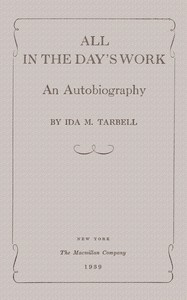
ALL IN THE DAY’S WORK
1
MY START IN LIFE
If it had not been for the Panic of 1857 and the long depression which
followed it I should have been born in Taylor County, Iowa. That was
what my father and mother had planned. In fact, however, I was born in a
log house in Erie County, Pennsylvania, on November 5, 1857. It was the
home of my pioneering maternal grandfather Walter Raleigh McCullough. No
home in which I have ever lived has left me with pleasanter memories of
itself. It was a Cape Cod house, a story and a half high, built of
matched hewn logs, its floors of narrow fitted oak planks, its walls
ceiled, its “upstairs” finished, a big fireplace in its living room.
There were spreading frame outbuildings to accommodate the multiple
activities of a farm which was in my time a going concern. I remember
best the big cool milk room with its dozens of filled pans on the racks,
its huge wooden bowl heaped with yellow butter on its way to the firkin,
its baskets piled with eggs, its plump dressed poultry ready for market.
Like all young married people of pioneer ancestry and experience having
their way to make, my parents wanted land. Land of their own, combined
with what my father could earn at his profession as a teacher and his
trade as a joiner, meant future security. It was the proved way of the
early American.
After much looking about in northwestern Pennsylvania where the families
of both were settled, they had decided that the West offered greater
opportunity and so in the spring of 1857, a year after his marriage, my
father, Franklin Sumner Tarbell by name, started out to find a farm. He
had but little money in his pocket, and the last one hundred fifty miles
of his search were made on foot. How enthusiastic he was over the claim
he at last secured! His letters tell of the splendid dome of sky which
covered it, of the far view over the prairie, of marvelous flowers and
birds, of the daily passing along the horizon of a stream of covered
wagons, settlers bound for California, Pikes Peak, Kansas, Nebraska; and
some of them, he found, were earlier Iowa settlers, leaving the very
state which for the moment seemed to him the gate to Paradise.
He set himself gaily at breaking land, building the house for mother,
working in a sawmill to pay for the lumber. He did it alone, even to the
making of window frames and doors. I know how he did it—whistling from
morning till night, mischief and tenderness chasing each other across
his blue eyes as he thought of my mother’s coming, their future
together.
The plan they had made provided for her going west with their household
goods in August. The money was arranged for, so they thought; but before
it was taken from the bank the panic came, and every county bank in
Pennsylvania was closed. There was no money anywhere, nothing for my
mother to do but stay where she was while my father struggled to earn by
teaching and carpenter work the money which would bring us on. But the
panic reached Iowa, dried up its money supply. People were living by
barter, my father reported. What a heartbreaking waiting it was for
them, coming as it did after an engagement of six years every week of
which they had both found long!
The fall and winter of 1857, the spring and summer of 1858 passed. Still
there was no money to be had, and then in the fall of 1858 father
started out to _teach_ his way to us. Before he found a school he had
walked one hundred and eighty miles—walked until his shoes and clothes
were worn and tattered. It was “shabby and broke,” as he had written it
would be, that he finally in the spring of 1859, when I was a year and a
half old, made his way back to my mother still living in the log house
in Erie County.
According to the family annals I deeply resented the intimacy between
the strange man and my mother, so far my exclusive possession. Flinging
my arms about my mother, so the story went, I cried, “Go away, bad man.”




Comments
Loading comments…